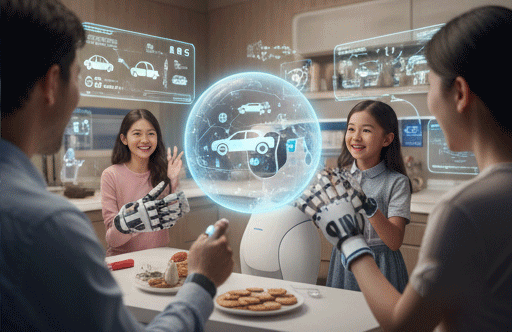
On January 9, 2026 (local time), CES 2026—long regarded as the compass of the global tech industry—officially concluded its four-day journey. This year’s exhibition delivered a clear, practical answer to the question, “What can AI do?”
The answer: “AI is already acting in our daily lives.”
Based on the final-day wrap-ups and “Best of CES” announcements, here are the key technology trends set to define 2026.
[CES 2026 Wrap-Up] “AI Moves Beyond the Lab and into Daily Life” — Four Core Keywords
1. The True Winner of CES 2026: The Mainstreaming of “Physical AI”
The single term that defined CES 2026 was Physical AI.
If last year’s AI lived on screens through text and images, this year it fully entered the physical world—through robot arms and vehicle wheels.
Best Robot of CES:
Hyundai Motor Group and Boston Dynamics’ electric Atlas humanoid took top honors. With overwhelming mobility and maintainability, it signaled that real industrial deployment is imminent.
Everyday integration:
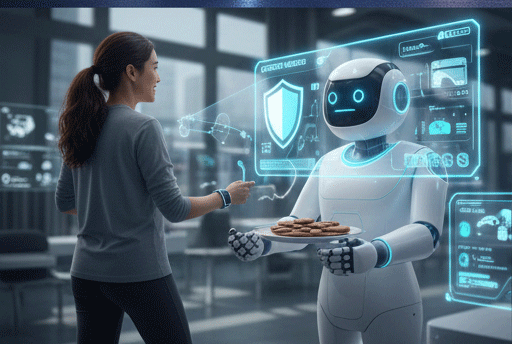
LG’s towel-folding robot and Samsung’s AI kitchen assistant systems demonstrated that the “liberation from housework” is no longer a distant vision, but a practical consumer solution.

2. The Overwhelming Rise of “K-Innovation”: 59% of Innovation Awards
CES 2026 was so dominated by Korean companies that some dubbed it a “Korea Electronics Show.”
Record-breaking performance:
Nearly 60% of all Innovation Awards went to Korean companies, including conglomerates and startups alike.
Startup surge:
Notably, SMEs and startups accounted for nearly 80% of Korean award winners, proving that Korea’s AI ecosystem is expanding beyond large enterprises into a strong deep-tech startup base.

3. The Standardization of “On-Device AI”: Intelligence Without the Internet
On-device AI—which operates without cloud connectivity—has become a default feature across devices.
Privacy and speed:
For security-sensitive healthcare wearables and real-time autonomous vehicles, on-device AI is no longer optional—it is essential.
Next-generation PCs and mobile devices:
AI PCs capable of running 100-billion-parameter large language models locally, without internet access, made their debut, signaling a fundamental shift in how people work.

4. From Mobility to Spatial Computing: Cars Become Living Spaces
Cars are no longer just transportation tools—they are being redefined as massive mobile IT environments.
Holographic windshields:
Front windshields transformed into transparent displays, delivering driving data and immersive entertainment simultaneously.
SDVs (Software-Defined Vehicles):
Vehicles whose intelligence evolves through software updates, rather than hardware upgrades, emerged as the new market standard.

💡 After CES 2026: The Shifts We Must Watch
CES 2026 delivered a clear message: “The AI hype era is over. This is the era of execution.”
The age of action:
Success will now depend less on technological spectacle and more on how meaningfully AI improves everyday user experience.
Security and ethics:
As AI gains physical presence, social consensus on robot and autonomous-vehicle safety, security, and responsibility will become increasingly critical.
Korea’s opportunity:
Korea’s **full-stack capability—spanning hardware and software—**positions it as one of the strongest competitors in the global AI market.
#CES2026WrapUp
#PhysicalAI
#HumanoidRobots
#AtlasRobot
#KStartupInnovation
#OnDeviceAI
#HolographicDisplay
#DigitalHealthcare2026
#2026TechTrends
#NVIDIACES


