(Samsung Electronics Outlook 2026)
“₩200,000 Samsung” Becoming Reality? — Analyzing the HBM4 and Foundry Counteroffensive
As of January 2026, Samsung Electronics is riding a historic earnings rally, driven by two powerful forces: the return of the semiconductor supercycle and the recapture of leadership in the AI memory market.
Based on forecasts from major investment firms and global media, here is a consolidated outlook on Samsung’s stock trajectory and key risk factors.
1. Stock Price and Earnings Outlook: “Unprecedented Performance”
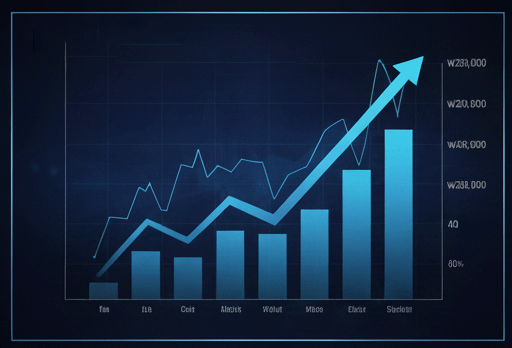
Domestic and global securities firms expect Samsung Electronics to deliver its strongest results in eight years (since 2018), raising target prices from ₩150,000 to as high as ₩240,000
→ approximately $102 to $163 per share.
The dawn of the “$136 Samsung” era:
KB Securities and Citi suggest ₩180,000–₩200,000 ($122–$136), while Macquarie points to a potential upside of ₩240,000 (~$163), indicating Samsung has entered a full re-rating phase.
Record-high operating profit forecast:
Consensus estimates for 2026 operating profit range from ₩100 trillion to ₩145 trillion
→ approximately $68 billion to $99 billion.
The semiconductor (DS) division alone is expected to generate over ₩60 trillion
→ more than $41 billion.
HBM4 as a market game changer:
Samsung’s share in the HBM4 (6th-generation) supply chain — set to power NVIDIA’s next-generation AI platform “Rubin” — is projected to surge from 16% in 2025 to over 35% in 2026.
Tailwinds from conventional memory:
Beyond AI, shortages in DDR5 and enterprise SSDs (eSSD) for data centers are intensifying. With roughly 70% of its DRAM capacity allocated to mainstream products, Samsung is positioned as a primary beneficiary.

2. Core Investment Thesis: Why Now?
HBM4 mass production in sight:
Samsung has reportedly received strong evaluations in NVIDIA’s HBM4 qualification tests, with full-scale supply expansion expected from Q2 2026.
Revival of the foundry business:
A next-generation autonomous driving chip deal with Tesla (AI5/AI6), estimated at $16.5 billion, has validated Samsung’s 2nm and 3nm advanced processes, signaling a potential turnaround to profitability in non-memory operations.
Overwhelming cash flow:
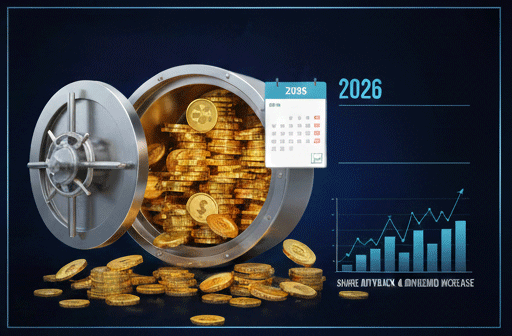
Massive expected free cash flow in 2026, alongside expanded share buybacks and dividend programs, is providing strong downside support for the stock.
3. Key Risk Factors: Caution Amid Optimism
Rising costs and device-business pressure:
Higher semiconductor prices could increase cost burdens in smartphones (MX) and consumer electronics (CE), partially offsetting margin expansion.
Geopolitical and regulatory risks:
U.S. tariff policy shifts and semiconductor export restrictions to China remain significant macroeconomic variables.
Valuation pressure:
After the recent sharp rally, elevated P/E multiples mean any earnings miss could trigger short-term volatility.
Intensifying competition:
With SK hynix’s entrenched leadership and Micron’s aggressive pursuit, competition for memory market share is expected to accelerate.

💡 Investment Strategy: “The Return of the Memory King”
Samsung Electronics is no longer viewed merely as a memory manufacturer, but increasingly as a core partner in global AI infrastructure.
While short-term pullbacks are possible, a long-term holding and buy-on-dips strategy appears justified, considering the full earnings impact of HBM4 in the second half of 2026 and the ongoing foundry turnaround.


